Most homeowners never think about attic ventilation until something goes wrong: shingles aging early, frost on the underside of the roof boards in January, or an upstairs bedroom that bakes in July.
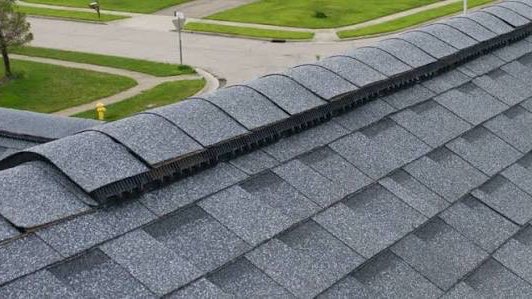
Most attics need exhaust at the top, such as a ridge vent, paired with intake at the eaves. The residential code calls for 1 square foot of vent area per 150 square feet of attic floor, or per 300 with balanced venting.
It's easy to check, and cheap to fix during a re-roof.
Why does attic ventilation matter for a roof?
Attic ventilation matters because a closed, hot attic ages shingles from underneath in summer and traps moisture in winter. Good airflow keeps the roof deck close to outside temperature, which also stops the uneven melting that starts ice dams.
In summer, an unvented attic can run far hotter than the air outside, cooking the shingles above it. In winter, warm, moist air from the house condenses on cold roof boards, leading to mold and soft decking. Both problems shorten the life of the roof and can affect the shingle warranty.
How much ventilation does an attic need?
An attic needs 1 square foot of net free vent area per 150 square feet of floor under residential code section R806.2. That drops to 1 per 300 when 40 to 50 percent of the vent area sits high near the ridge and the rest low as intake.
For a 1,200 square foot attic, that's about 4 square feet of balanced venting, split between the ridge and the eaves. Intake matters as much as exhaust. A ridge vent with no soffit intake just pulls air from the house below.
What are the signs of poor attic ventilation?
Poor attic ventilation shows in five common signs: frost or dark staining on the underside of the roof boards, a musty attic smell, ice dams along the eaves, an upstairs that stays hot into the evening, and shingles blistering or curling early.
Older Verona homes often have little more than a pair of gable vents, and some 1920s attics were later insulated in ways that blocked the eave openings. Both are easy to check from the attic with a flashlight.
Can a roof have too much ventilation?
Too much ventilation is rarely the problem; mixed exhaust vents are. A ridge vent next to gable vents or a powered fan can pull air from the nearest opening instead of from the eaves, leaving most of the attic still.
The goal isn't the most vents possible; it's one clear path from low intake to high exhaust. That's why we usually recommend one exhaust type per attic space and closing old gable vents once a ridge vent goes in. Air sealing matters too. Gaps around attic hatches, recessed lights and plumbing stacks let warm, damp house air into the attic, and no amount of venting fully makes up for that. Sealing those openings from the attic side is one of the cheapest ways to cut ice dams and condensation together.
When should a ridge vent be added?
A ridge vent is best added during a roof replacement, when the ridge is already open and the cost is small. Adding one to an existing roof is possible but means cutting the deck and replacing the ridge caps.
We pair the ridge vent with intake at the eaves wherever the overhang allows it, and close off old gable vents so the air doesn't short-circuit. Roofs with complex hips, like many Tudors, may need other exhaust options, which we'll explain on site.
Not sure what your attic has? Ask for it during a free roof inspection.
Need help with this in Verona?
We'll take a look and give you a free written quote. Learn more about roof repair in Verona.